
MRP is concept that we can all understand (SAP Business One)
2026.02.03
General impression of MRP
MRP is a term that inevitably comes up in any conversation about manufacturing systems. It is also included in SAP Business One as a standard feature. Even though it is regarded as an essential tool in manufacturing, the general impression of MRP is somewhat mixed.
Examples of comments that we get about MRP are:
- We don’t understand the calculation.
- The result of the calculation was different from what we had expected.
- We understand the calculation, but it is difficult to manage on a daily basis.
First of all, what is MRP?
The system was devised in the 1960s, with the purpose of eliminating inventory excess and shortages.
From that time until now, the key problems in inventory control can be summed up as follows:
- As the number of handled items increases, the time required to keep track of inventory movement also increases.
- Particularly in the manufacturing industry, the complexity of relationships between parts, subassemblies and assemblies needed to produce a finished product makes it nearly impossible to understand all of the inventory relationships.
- Multiple lead time dependencies, meaning aligning the schedules of purchasing raw materials, manufacturing parts and delivering products, is a complex and time-consuming process.
Behind all of these lies the simple fact that it is far too time-consuming to calculate everything manually. MRP is a system that can eliminate that. In other words, it would not be wrong to describe MRP as a high‑performance calculator. In fact, in Japan some people refer to MRP not as “Material Requirements Planning” but as “Material Requirements Calculation”, a phrasing that emphasizes the system’s role in performing complex calculations.
MRP in SAP Business One
Let’s have a look at what MRP actually looks like in SAP Business One. Below is an example of the result of a MRP calculation.
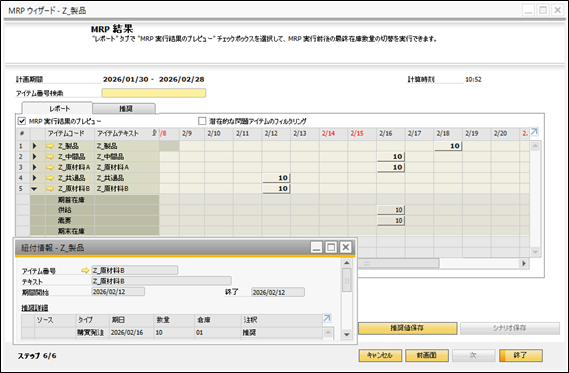
This result indicates that 10 units of the finished product are needed by February 18th, and according to the bill of materials, 10 units of raw material B, required for producing the finished product, should be ordered by February 12th.
If we compare the MRP in SAP Business One with the ones in software packages dedicated to production management, it certainly appears simpler and less likely to leave users confused while they try to resolve the above-mentioned inventory issues. Since it is easy to use, even for those with no prior experience with MRP, this makes it a perfect choice for small and medium-sized enterprises with limited human resources.
Although running a MRP calculation in SAP Business One is relatively easy compared to managing spreadsheets or complex production management software, it is important to know how to prepare master data, configure system parameters, and interpret results.
If you are interested in learning more about SAP Business One and MRP, please feel free to contact us for more information.